|
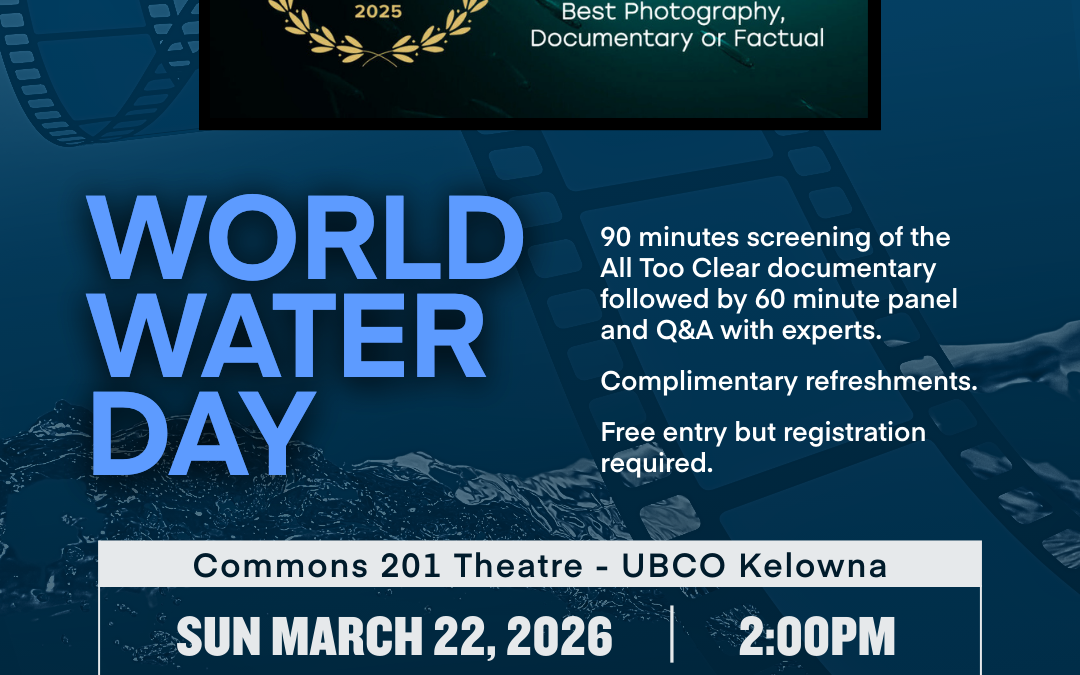
Syilx Territory, Kelowna, B.C. – In recognition of World Water Day, the Okanagan Basin Water Board (OBWB) and the Department of Earth and Environmental Sciences at the University of British Columbia Okanagan (UBCO) invite the community to a free screening of the award‑winning freshwater documentary All Too Clear on Sunday, March 22, 2026. The 90‑minute film will be followed by a 60‑minute expert panel and audience Q&A, with complimentary refreshments. Admission is free, but advance registration is required.
The featured film, All Too Clear, examines how quadrillions of invasive quagga mussels are transforming the Great Lakes at a scale not seen since the glaciers — raising urgent questions about what a similar invasion would mean for the Okanagan’s drinking water, fisheries, real estate values, tourism, recreation economy, and cultural value.
“What’s happening in the Great Lakes is a warning we can’t ignore,” says James Littley, Chief Operating Officer of the OBWB. “Invasive mussels may seem small, but the damage they cause is enormous — from clogging water intakes and harming fish habitat to devastating beaches and infrastructure. Events like this help our community understand the stakes and strengthen our shared commitment to keeping these invasive species out of the Okanagan.”
The OBWB has long been a leader in invasive mussel prevention through its Don’t Move a Mussel program. This event supports the Board’s mandate to protect Okanagan water resources by fostering awareness about threats that could dramatically alter the valley’s lakes, ecosystems, and economy.
Following the screening, regional experts will discuss local implications, resilience strategies, and community actions to protect the basin. Panelists include;
Eleanor Duifhuis, Fisheries Biologist – Columbia Region | Okanagan Nation Alliance
Derek Gratz, Associate Director | Innovation UBC Okanagan and President | Kelowna Chamber
Jesse Zeman, Executive Director | B.C. Wildlife Federation
James Littley, Chief Operating Officer | Okanagan Basin Water Board
The panel will be moderated by UBCO Lecturer and OBWB Water Stewardship Director, Dr. Nelson Jatel.
Event details at-a-glance
What: All Too Clear film screening followed by expert panel and Q&A — refreshments provided
When: Sunday, March 22, 2026, 2:00 p.m. – 5:00 p.m. (doors open at 1:30 p.m.)
Where: Commons 201 Theatre, UBCO, 3297 University Way, Kelowna
Cost: Free (registration required) — https://WWD2026AllTooClear.eventbrite.ca
Who should attend: Community members, water professionals, policymakers, educators, students, and anyone who cares about freshwater.
About All Too Clear
Filmed with cutting‑edge underwater drones (ROVs), All Too Clear immerses audiences in a rarely seen freshwater world — from dazzling near‑shore habitats to the deep, biologically diminished offshore zones of the Great Lakes. This feature follows the life cycle of lake whitefish while spotlighting scientists who are confronting the mussel invasion and seeking pathways to restore native species and food webs. The filmmakers’ extensive underwater work has also contributed to scientific insights and included the discovery of the 1895 SS Africa shipwreck in Lake Huron.
The film is directed by Yvonne Drebert and Zach Melnick of Inspired Planet Productions and features leading researchers including Dr. Ashley Elgin (NOAA Great Lakes Environmental Research Laboratory) and Professor Harvey Bootsma (University of Wisconsin–Milwaukee). Dr. Elgin notes in the film that “every gallon of water in Lake Michigan could have passed through a mussel in a week,” underscoring the immense scale of the threat.
Why this matters for the Okanagan
The OBWB has warned for more than a decade that the introduction of invasive mussels into Okanagan waters would result in tens of millions of dollars annually in infrastructure damage, ecological collapse, and irreversible impacts to beaches, drinking water systems, fish habitat, and tourism. Through its advocacy and education work, the OBWB continues to push for stronger provincial and federal protections, border inspections, and community vigilance.
This World Water Day event supports that mission by giving residents a deeper understanding of what is at stake — and how collective action can protect one of Canada’s most water‑stressed regions.
About the panel
Eleanor Duifhuis has worked with the Okanagan Nation Alliance since 2018 and is a Fisheries Biologist with RPBio accreditation. She manages several projects from the Castlegar office relating to invasive mussel monitoring, rainbow trout spawning channel monitoring and maintenance, and mid-Columbia River sturgeon monitoring.
Derek Gratz leads the Innovation UBC team at the Okanagan campus. In this role, Derek assists companies and organizations (like OBWB) to connect with and sponsor UBC researchers on cutting edge research, manages patents and intellectual property arising from UBC research, and assists UBC entrepreneurs with creating new start-up companies to commercialize new innovations. He is also the President of the Kelowna Chamber of Commerce and past chair of the Chamber Policy Committee, and has also served on the OBWB Water Stewardship Council for several years. He and the policy committee of the Chamber have been proactive advocates with OBWB for fighting invasive mussels and working to stop their spread into western Canada.
Jesse Zeman is Executive Director of the British Columbia Wildlife Federation, British Columbia’s largest and most active conservation organization. He assumed the role in 2021 after nearly a decade with the Federation, including serving as Director of Fish and Wildlife Restoration. Jesse holds a Master of Arts in Sustainability from the University of British Columbia and an Honours BBA and Commercial Aviation Diploma from Okanagan College. His background includes work in aviation, outdoor recreation, and conservation policy.
James Littley oversees OBWB’s core programs as Chief Operating Officer, including milfoil control, invasive species prevention and grants programs, and helps lead financial management, and partnerships with local governments, Indigenous communities, and stakeholders. Since joining OBWB in 2012, he has played a key role in expanding invasive species prevention efforts.
Dr. Nelson Jatel is a passionate leader in water management and social network analysis, serving as Water Stewardship Director for the OBWB for the past 19 years. His work focuses on ensuring our waters are safe to drink, swim, and fish in, blending science with community engagement to solve complex water challenges.
|